

Sin - Holy Scripture - Hell
as modern idols
Where do idols come from?
We owe much to those who have gone before us, especially since modern Christianity knows so little about many of the Early Church leaders. Just because someone was an Early Church Father (leader) doesn't mean that everything they thought or wrote represented the character, nature, and fiber of God(F,S,S). Tertullian was an early church leader of the Western (Roman) Church. His negative contributions to our modern Christian sacrificial system do not disqualify his positive contributions. The same is true for all of us, including Augustine and other Western Church leaders. The same is also true for the Eastern Church Fathers (leaders), yet not in the same ways.
An idol is someone or something you depend on for your identity and self-value. It is someone or something you look to for guidance and help. Formulas, ritual, and sacrificial systems are almost always involved. There is usually an emotional or mental contract involved. Performance is almost always are part of the contract. There is typically a trade or "quid pro quo" involved. On a different level, think of idols like modern-day influencers. Not that being an "influencer" makes a person "bad" or "evil." Think of it more in the sense of affecting how people think and believe about God and themselves.
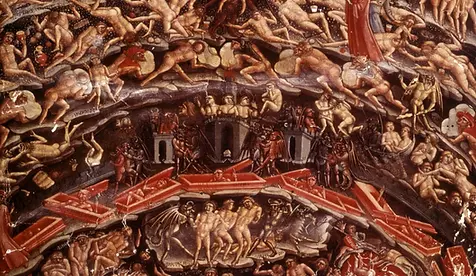
Additional information will be posted here at a later time about the unGodly legacy of other well-meaning, not perfect leaders and influencers. For right now, let's take a look at Dante and the influence of his imagery of hell. Dante was an influencer. He, among many others, has influenced a majority of modern-day Christians to embrace pagan influenced concepts of God and the afterlife. Many "Christians" have experienced "salvation" as a response to fear of what happens in the afterlife, instead of being created anew by the Love (F,S,S) Jesus has invited them into.
That said, this statement by no means devalues any person's receiving and experiencing Jesus' invitation, regardless of the religious or pagan-influenced doctrines embraced by the person. Jesus' invitation is greater! Jesus will be faithful to refine our perspectives that are not consistent with the relationship of God(F,S,S). "We will all be salted by the fire🔥of God." - Mark 9:49
The challenge that we all face, including the early church leaders, feels something like the following statement:
Our effort to understand God as the Father, Son, and Holy Spirit (an Infinite mystery of Oneness) brings meaning as we attempt to describe the indescribable, an impossible endeavor. How do we expect ourselves to describe what the infinite is by using the finite languages of humans? We do our best as we lean into the grace that is afforded us. As we experience God's presence with&in us, we find God's heart for us as we afford that same grace to each other.
"Meet Tertullian: A Roman Lawyer Who Helped Shape the Concept of Eternal Damnation" - Darrel Amy
Have Christian's made the Bible into an idol?
Short Explanation:
The Bible is special and powerful because God inspired it to tell us the truth about Jesus. However, the Bible becomes an "idol" (something we elevate to the same level as God) if we care more about the written words and our own ideas than we care about Jesus. The best way to live is to respect the Bible as our guide while keeping our hearts focused on Jesus, the Living Word, and listening to the Holy Spirit within our interactions with&in the presence of God(F,S,S) in others. This keeps us from worshipping written words on scrolls or in books instead of the Logos of God (Jesus).


Before we take a look at the longer explanation, there are a few thoughts and perspectives that are very important to consider.
Grace & Freedom
*Grace is not the apologist for sin, but the nursemaid of righteousness. Grace is not an excuse to behave badly—it is the power to live in freedom as uniquely expressed by Holy Spirit in you. It is for freedom that Christ has set us free. Freedom is not doing what our false version of ourselves (the version not recognizing the identity of God(F,S,S) with&in us seems to want to do or living out some forced will of God, but participating in love and Union to be who we truly are. - Rod Williams
"I have been put to death on the cross with Christ; still I am living; no longer I, but Christ is living in me; and that life which I now am living in the flesh I am living by faith, the faith of the Son of God, who in love for me, gave himself up for me" —Gal. 2:20, BAS (Basic English Version)
“When I am raised to life again, you will know that I am in my Father, and you are in me, and I am in you.” —John 14:20, NLT
*Jesus did not die alone. He did not rise alone. He removed the sting of death for you. This is why you can believe. - Rod Williams
“For Christ’s love compels us, because we are convinced that One died for all, therefore all died.” —2 Cor. 5:14
“If I ascend into heaven, You are there; If I make my bed in hell, behold, You are there.” —Psalm 139:8
“‘O Death, where is your sting? O Hades, where is your victory?’ The sting of death is sin, and the strength of sin is the law. But thanks be to God, who gives us the victory through our Lord Jesus Christ.” —1 Cor. 15:55-58
Longer Explanation:
When absolutized in practice—both sola scriptura and a rigid doctrine of inerrancy function as forms of idolatry.
None of the following commenatary deminishes the power and sacred nature of Scripture. It does the opposite. When appropriately understood and respected, the power of Scripture is unleashed to speak as God(F,S,S) intended and not divorced from its human authors, their context and their limitations. Scripture is both a revelation and testimony of human finite limitations incontrast to the revelation of God's infinite presence with&in the lives of those presented to us in Scripture.
1) Definition of terms and the theological concern:
-
Sola scriptura (the modern understanding): "Scripture alone is the final, normative rule for Christian faith and life." In many formulations it did not deny the value of tradition, reason, or the church’s teaching office, but claimed Scripture’s role as preeminent.
-
Biblical inerrancy (as developed in modern Protestanism): the Bible, properly interpreted, is without error in all that it affirms (some versions limit this to matters of faith and practice; others extend it to historical and scientific particulars).
-
Idolatry (biblical/theological sense): making something other than God the ultimate object of trust, allegiance and "worship" (Exod. 20:3; Isa. 44:9–20; Col. 3:5). Idolatry can be both concrete (statues) and abstract (an ultimate reliance on a created thing).
Origins and Formalizations: The infallibility of the Pope & Inerrancy of Scripture
-
Catholicism - the First Ecumenical Council of the Vatican of 1869–1870
-
Protestantism - the International Council on Biblical Inerrancy, held in Chicago in October 1978
Both are idols of men under whose "authority" you are expected to submit.
The claim: when sola scriptura or inerrancy is absolutized so that the written text itself (or one’s reading of it) becomes the ultimate, unquestioned authority—even if inadvertantly above Christ himself, the living Word—then that stance can functionally become idolatry or “bibliolatry.” This is a significant factor for why we have so many denominations.
2) Biblical and theological basis for the critique
-
Christ as the living Word (Logos): John 1:1–14 identifies the Word (Logos) with the incarnate Son: the ultimate revelation of God is a Person, Jesus Christ. Hebrews 1:1–3 likewise: God has spoken in the Son, who is the exact representation of God’s being.
-
Scripture as witness to the Word: Scripture testifies to Christ (Luke 24:27; John 5:39; 2 Tim. 3:16). Scripture is “God-breathed” (2 Tim. 3:16) and indispensable—but the New Testament consistently presents Scripture as pointing to, witnessing about, and being interpreted in the light of the living Christ (cf. Acts 17:2–3; Luke 24:25–27, 44–45).
-
The living, active character of God’s Word: Hebrews 4:12—“For the word of God is living and active…”—suggests that the “Word” is not merely inert ink but dynamic, and in context Hebrews points to the power of God’s speaking (which culminates in Christ).
-
Jesus' critique of religious legalism and empty textualism: Jesus criticized those who used Scripture/tradition in ways that obscured or nullified God’s command (Mark 7:6–13); he also rebuked reliance on human traditions that eclipsed God’s intent.
-
Spiritual illumination: 1 Corinthians 2:10–16 and John 16:13 emphasize the Spirit’s role in making God’s truth known. Scripture read apart from Spirit and church can be distorted.
-
Original language and context: As objective and honest followers of Jesus we own, as wtinesses of the Logos, that there are translational errors (short-comings at best). The English word, "propitation" is just one example that is presented on this website. If one chooses to make the arguments for sola scriptura or inerrancy, that argument can only ligitimately be made from the original languages. Even so, there are other limitations to making such a false and unnecessary claim as is presented on this website.
Propitiation: Jesus is our Mercy Seat, NOT a propitiation - PDF - the unbiblical English word that may be in our translated Bible
Taken together: Scripture is sacred as a preeminent witness to the Logos. Scripture’s true function and meaning is relationally bound to the living Word (Christ), the Spirit’s witness, and the interpretive community (the Church). If the written book is treated as the final object of trust in isolation from that relational matrix, faithful theology has reason to warn of idolatrous outcomes.
3) Patristic and later theological testimony
-
Early Church: the Fathers treated Scripture within the life of the Church and tradition. The canon’s authority was bound up with apostolic preaching and ecclesial reception (cf. Irenaeus, Athanasius). Scripture was never treated as a private, standalone absolute apart from liturgy, creeds, and episcopal authority.
-
Augustine: famously argued that we should trust the interpretation of the Church and the rule of catholic faith when reading Scripture (Augustine’s appeal to the “authority of the Church” in disputed matters). That is not an anti-Scripture stance but a corrective to private, idiosyncratic readings.
-
Thomas Aquinas: affirmed Scripture’s divine truth but subordinated the text to the ultimate Truth (God) and the interpretive work of the Church and reason.
-
Modern critics: scholars such as James Barr and others have argued that modern inerrancy often rests on naïve assumptions about language, genre, and ancient historiography; Barth and other 20th-century theologians insisted that Scripture becomes the Word of God in the event of witness and encounter, not merely by virtue of printed pages.
These testimonies show a long-standing ecclesial concern that Scripture be read interpretatively, sacramentally, and under the Spirit’s guidance—an approach that resists making the book itself the ultimate object of worship.
4) How sola scriptura/inerrancy can become bibliolatry in practice
-
Text-centered absolutism: when the Bible is worshipped in the sense that the text, an interpretation, or a particular translation becomes the absolute, unquestioned standard that overrides Christ-centered reading, the community’s relation to Christ is replaced by a relation to a text.
-
Private interpretation elevated: sola scriptura has often effectively become “solo scriptura”—the idea that private, unaided reading of the text is sufficient to settle every doctrinal dispute. This often produces fragmentation, doctrinal isolation, and claims of “I have the Bible on my side” that supplant ecclesial discernment.
-
Inerrancy as rhetorical shield: an inerrantist posture can become a method to immunize particular readings from critique, shutting down theological inquiry and historical-critical engagement. That defensive posture can make the Bible’s surface reading immune to the Spirit’s probing, thus turning it into an idol of intellectual security.
-
Displacement of the living Word: when piety focuses primarily on defending texts and syllabi—rather than on encounter with Christ—as the center of faith, the living Word is displaced by an objectified “written Word.”
Scripture is then loved for what it can do for human certainty (a role only God should fill), and thus the book becomes an object of ultimate trust—functionally idolatrous.
5) Scriptural evidence that would both critique and temper this judgment
-
2 Timothy 3:16 affirms Scripture’s divine origin and usefulness for teaching, reproof, correction, and training in righteousness. That supports high esteem for Scripture.
-
Acts 17:11 (Bereans) commends careful testing of teaching against the Scriptures—showing the Bible’s vital role in discernment.
-
The corrective balance: Scripture is necessary and authoritative, but its authority is not logically identical with infallible private readings, and Scripture’s authority is integrally connected to Christ and the Holy Spirit. Thus high view of Scripture but within a Christo-Trinitarian and ecclesial framework.
Compare and contrast: the infinite living Word (Logos, Jesus) vs.
the finite written Word (Scripture)
1) Ontological distinction
-
The Logos (John 1): ontologically infinite, personal, eternal. The Word (Logos) is the Second Person of the Trinity—person, action, relationship. He is not reducible to propositions on a page. The Word acts, creates, speaks, judges, and becomes flesh.
-
The written Word (Scripture): finite, humanly mediated, historical. Scripture is composed in human languages, cultures, and genres; it is a witness to the Logos, the vehicle by which the revelation is conveyed.
Implication: Christ is primary revelation; Scripture is the indispensable witness to that revelation. One is a Person (relational, living), the other is an witness of precious value.
2) Functional/mediational roles
-
Logos: active revelation—speaks now, reconciles, forgives, energizes. The living Word judges hearts and brings new life (Heb. 4:12; John 6:63).
-
Written Word: normative and formative—preserves apostolic witness, frames doctrine, forms communities, provides accountability. It functions as the rule of faith, but its power is exercised when the Spirit opens Scripture to persons and communities.
Thus Scripture’s authority is derivative and ministerial: it mediates the living Word’s self-revelation.
3) Epistemological dynamics (How we learn about God)
-
Meeting Jesus, the Living Word, is a personal experience. It happens when we listen to Him, feel the Holy Spirit, take part in church traditions like Communion, and share our faith with others.
-
Reading the Bible is not just looking at words; it requires us to think about history and ask the Holy Spirit for help to understand it. Because people see things differently, the same verses can mean different things depending on how someone looks at them.
Learning about God through the Bible doesn't happen automatically. It takes careful thinking and a spiritual connection. It is a mistake to act like the book itself is the most important thing in the universe when its real job is to lead us to Jesus.
4) Permanence and contingency (What lasts forever vs. what can change)
-
Jesus is God’s permanent way of showing us who He is. Who Jesus is does not change, even if a book is translated or copied differently.
-
The way the Bible was written and passed down can change. There are different translations, small differences in old copies, and different cultures to consider. This means we must be humble when we explain what a verse means. Sometimes, people try so hard to say the Bible is perfect that they forget it was written by humans in a specific time and place.
5) Pastoral and ecclesial consequences (How this affects the Church and its people)
-
When we focus on Jesus, it helps us worship better, follow Him more closely, and tell others about His love and His work.
-
If we focus too much on the written words without remembering they point to Jesus, we might become too bossy about rules, start arguments with other Christians, and fight over words instead of loving people.
Rebuttals and balance: Why some people defend these ideas
-
The Reformers' ideas: Many early church leaders used "Scripture Alone" to make sure no one taught things that went against the Bible. They didn't mean we should ignore the Holy Spirit or the history of the Church. They just wanted the Bible to be the final guide.
-
Why people like Inerrancy: People who believe the Bible has no "errors" say this helps keep the message of Jesus safe. It gives them confidence that the Bible is a trustworthy map that leads them to Christ.
When used correctly, these ideas are not bad. They only become a problem when people treat the Bible like a statue to be worshipped instead of a guide to the living God.
A constructive, theological corrective (Practical steps to take)
-
Keep the focus on Jesus: Read the Bible to find Jesus. The Bible is important because it points to Him and shows how He fulfilled God’s promises.
-
Read together with the Church: Don't just try to figure it out all by yourself. Reading the Bible during church services and talking about it with other Christians helps us stay on the right track.
-
Ask the Holy Spirit for help: Always remember that we need the Holy Spirit to help us understand the truth. This keeps us from being too stubborn or ignoring the Bible's message.
-
Be humble about how you read: Remember that the Bible has different types of writing, like poetry and history. Don't treat it like a boring list of laws; treat it like a deep message from God.
-
Respect the Bible without worshipping the written words: Treat the Bible with great respect as God’s message, but don't act like a specific translation or your own personal opinion describes the indescrible God(F,S,S).
Sin
-
Sin Is Not A Legal Problem – Athanasius and the Atonement
website - https://glory2godforallthings.com/2016/07/12/sin-not-legal-problem-athanasius-atonement/
Holy Scripture
A Few Ancient Practices For Modern Discipleship (ft. Marty Solomon - The Bema Podcast) (32:07)
Tim Mackie - What Many Christians Misunderstand About The Bible (28:42)
Marty Solomon - deep dive into Genesis - how Western Christianity often misses the depth of scripture’s original intent.
(1:02:21)
What did Christians do before the Bible? (32:32)
How to read/interpret the Bible through an “Eastern vs. Western” lens by Jewish Scholar Marty (62:00)
* Supernatural World in Scripture - Michael Heiser (Ancient Hebrew Scholar) (12:51)
aionios, the Greek word translated as "eternal" and "everlasting" in the Bible (eternal? hell) (21:00)
There are contradictions in the Bible* (10:21)
Fr John Behr: When, Why, and How should We Read the Scriptures? (1:05:22)
* "Contradictions" in Sacred Scripture do not mean that Scripture is not inspired. Reasons for what seems to be contradictory: mistranslation, lack of understanding of relevant context (culture differences, scriptural language referencing other parts of scripture or stories or books the audience would have been familiar with that we are not. What appears to us as a contradiction may be relevant to the story/narrative that God intended for us to receive.
Fr John Behr - Unlearning Theology, the Problem of "the Bible", "Born Again"? (1:00:45)
Scripture, Tradition, and the Canon - Fr John Behr (1:08:17)
"Hell" (Gehenna, Hades, Tartarus, Sheol, etc)
"All of us will be salted by the fire of God(F,S,S)." - Mark 9:49
How Christ's Descent to Hades Relates to Our Salvation + Does It Show Up in TV (Stranger Things) (18:51)
Hell. Has It Always Been Forever? (6:49)
The 'Hell' You Were Taught Isn't in the Bible (18:56)
The concept of Hell (17:38)
Many Christians don't know what the Greek word for "eternal" means (4:26)
The Narrow Gate Has a Word Every Bible Missed (17:50)
Weeping and Gnashing of Teeth Isn't About Hell (16:09)
Hell Is Not Separation From God Stop Saying That (4:32)